
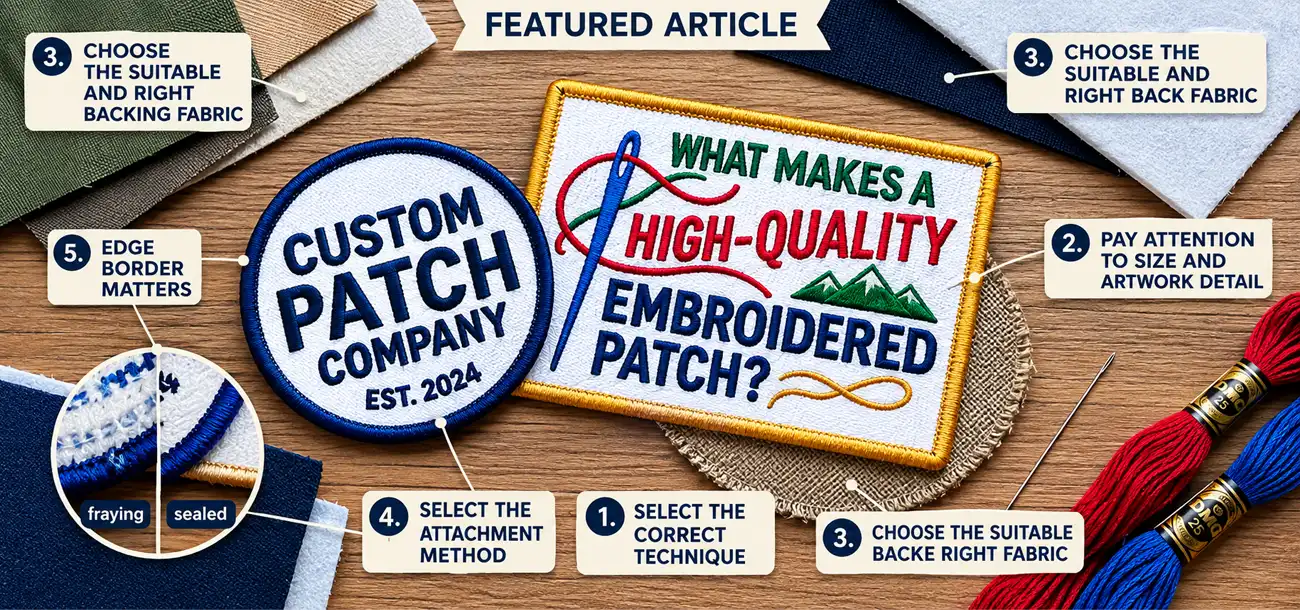
Embroidered patches have been around for a very long time. To tell you the truth, they have been around since at least the 5th century.
However, the majority of people understand them quickly; they possibly never consider. Or they do not know how they are created or why they are used.
As Embroidery patches UK are among the most famous and widespread practices to customise clothes, embody identity, and also display branding,
These patches have become essential in many domains, such as sports, fashion brands, and corporate and industrial use.
However, once the patches arrive, they are not what you proposed. The threads are fraying, and the colors are mostly dull. Also, the patches themselves feel fragile.
You must be upset, since you understand that the materials used to create your patches are only as essential as the design itself. To find out more about the types of patches, materials used, designs, and their quality, the complete guide to custom patches can help you gain the knowledge that you require.
What makes a top-notch embroidery patch? Let’s find out in the next section in detail.
Understanding Embroidery
An embroidered patch is a smaller part of fabric or material. It has the design embellished on it with the use of colorful thread.
So, rather than pen art, it is a skill that is done with a needle. Moreover, you can sew a patch on, stick it on with Velcro, or iron it on.
Every patch is soft, flexible, and tough. If you are customising a denim jacket, branding uniforms, or adding flair to accessories, these patches have become indispensable in both branding and fashion domains.
Different Types of Patches Used in Embroidery
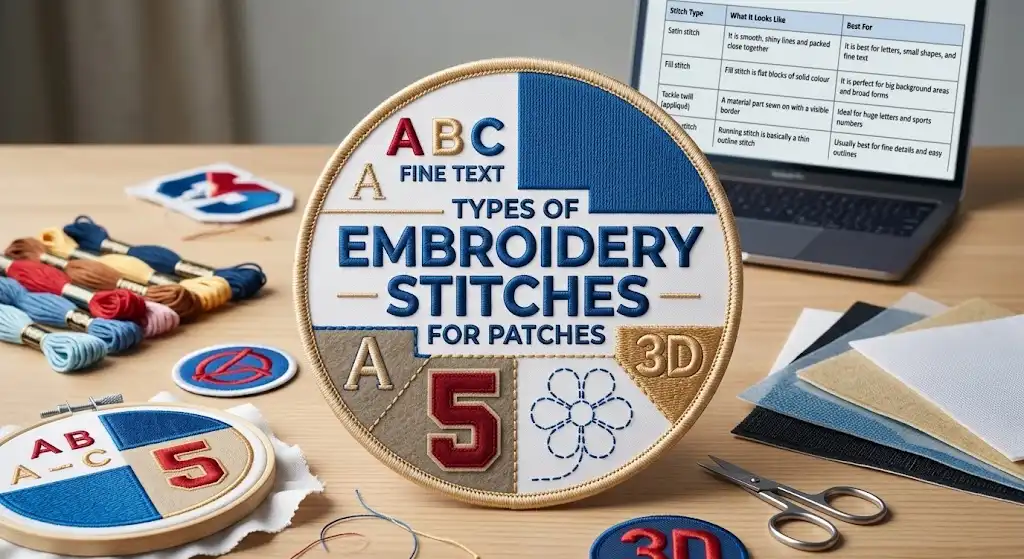
These are the best backing materials for embroidery patches. The choice of proper backing material plays an important role in making your patch strong, durable, and comfortable. Various kinds of backing materials are appropriate for various items of clothing.
| Stitch Type | What It Looks Like | Best For |
|---|---|---|
| Satin stitch | It is smooth, shiny lines packed close together | It is best for letters, small shapes, and fine text |
| Fill stitch | Fill stitch is flat blocks of solid colour | It is perfect for big background areas and broad forms |
| Tackle twill (appliqué) | A material part sewn on with a visible border | Ideal for huge letters and sports numbers |
| Running stitch | Running stitch is basically a thin outline stitch | Usually best for fine details and easy outlines |
| 3D or puff stitch | Raised, foam-filled stitching | Bold logos that stand up off the patch |
How to Identify a Premium Embroidered Patch?
You can identify and classify premium embroidery patches in the UK by looking at the back of the patch.
The majority of iron-on patches have a smooth, shiny, or slightly glossy adhesive coating that triggers with heat.
Sew-on patches, meanwhile, usually have plain material or thread support and no glue.
Here are the step-by-step tips to identify a top-notch and superior embroidered patch.
1. Select the Correct Embroidery Technique
There are plenty of different kinds of embroidery patch methods you can use. But remember different embroidery practices impact appearance, texture, durability, and cost.
Buying tips
- Complex and tricky logos- Always choose computer embroidery
- Huge graphic areas- Integrate with printing with embroidery
- Best appearance-To get the best appearance, you must think about purchasing 3D embroidery.
2. Pay Attention to Size and Artwork Detail
Pay attention to size and artwork detail. As embroidery is different from printing. Tricky details and minor text might not be recreated in embroidery clearly.
Recommended specifications
- Minimum text height- 5mm or more
- Minimum line width- 1mm or more
- Remember, the minor patches fit for gradient strong artwork.
Here are the common issues to avoid
- Text must not become unreadable
- The fine logo details must not vanish
- Edge distortion happens
Solutions to adopt
- You have to simplify artwork
- You must increase the size of the patch
- Finally, always use printed features with embroidered borders
3. Choose the Suitable and Right backing fabric
The backing fabric you use impacts durability and the overall appearance.
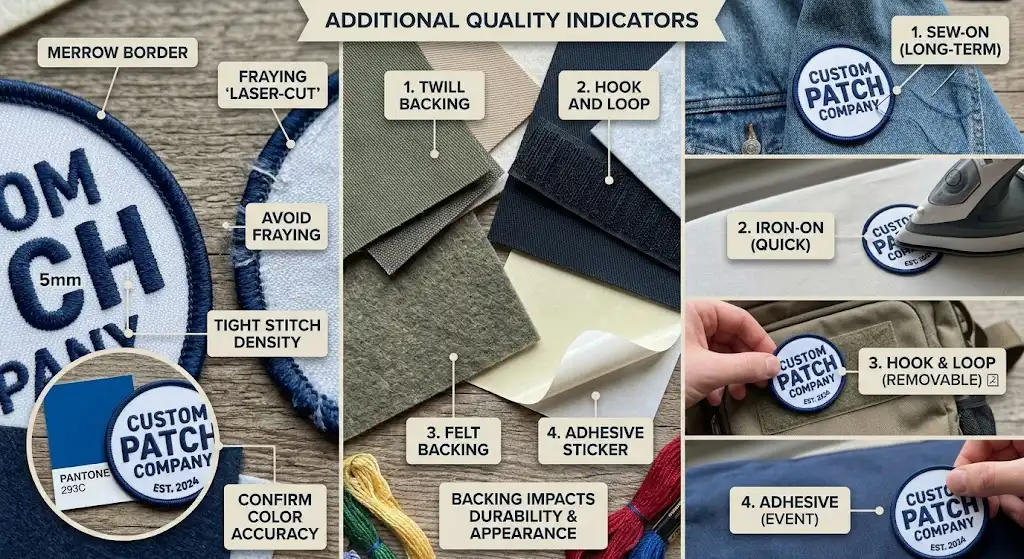
1. Fabric
- Twill material
- Non-woven material
- Hook and loop backing
- Felt fabric
- PVC backing
2. Features
- Here are some key features of using the right backing fabric.
- Most are common and tough
- Quality materials are commonly economical
- These fabrics are for tactical and military use
- These are thick and vintage-style
- Finally, quality and premium embroidery patches UK are waterproof and weather-resistant.
Here are the recommended suggestions
- Outdoor use- These are solid and waterproof fabrics
- Premium fashion- Use high-density twill
- Tactical and strategic applications- Consider purchasing hook-and-loop backing
4. Select the Correct Attachment Method
Here are the common attachment choices available that you can use in embroidery.
| Attachment Type | Pros | Cons |
|---|---|---|
| Sew–on | These are mostly solid and long-lasting | Need sewing |
| Iron-on adhesive | Quick and easy | Iron-on adhesive might loosen or damage if washed again and again |
| Hook and Loop | These are easily consumable and removable | Mostly expensive |
| Adhesive sticker backing | Best for temporary events | Decrease durability |
Suggestions for choosing the best one
- For longer-term uniform use: Always choose sew-on
- For event application: Select iron-on
- Tactical gear: Always consider buying hook and loop
5. Edge Border Quality Matters
The finishing directly impacts both the durability and appearance of premium Fashion & Promotional Patches.
Common and most widely used border kinds
- Merrow border
- Laser-cut edge
- Heat cut edge
- Borderless design
Some essential considerations you must know before purchasing quality embroidery patches UK
- Irregular shapes- For irregular shapes, consider laser cut, and these are recommended
- Traditional round patches- For solid durability and longer-term use, use a merrow border
- Remember, a lack of edge finishing might cause fraying
6. Confirm Color Accuracy and Sampling
Embroidery patch colors may vary, depending on lighting and fabric materials.
The suggested practice
- First of all, you have to offer AI or PDF vector artwork
- Clarify Pantone color codes
- Allow a physical sample
- Lastly, proceed to mass production
Key notes
- The screen colors ≠ the actual thread colors.
- Dark fabric background colors might impact visual presence
7. MOQ (Minimum Order Quantity) and lead time
Common industry standards
| Item | Typical Range |
|---|---|
| MOQ | 50 to 300 pcs |
| Sample production | 3 to 7 days |
| Mass production | 7 to 20 days |
Buying Suggestions
- Small quantity orders- You have to find flexible manufacturers
- Huge OEM projects- You have to clarify and confirm production capacity
8. Evaluate OEM/ ODM Manufacturing Skills
An experienced patches manufacturer must offer far more than basic production services.
Here are the ideal OEM/ ODM support services you have to add.
- Artwork optimisation
- Structural design consultation
- Color-identical ideas
- Sample revisions
- Quality control
- Packaging services
- Export compliance support
What is the Best Thread for Embroidered Patches?
Embroidery patches UK and Embroidery Digitising Explained are among the bestselling categories in the whole of UK custom patches.
But patch embroidery with quality thread will go viral easily. Once you design a patch online, you must choose the right thread. And it is not entirely in your control.
Below are the quality threads that will make your embroidery patches unmatched by any other patch maker.
Main factors to think about
- Weight: Remember, a 40-weight thread is the worldwide industry standard for embroidery digitizing and patch borders. You also need to balance fine detail with strong coverage.
- Durability needs: If the patch is on a uniform, backpack, or even outdoor gear, it will be exposed to sun and strong washing. For that, you must use polyester.
- Aesthetic needs: If you want maximum sheen for a decorative memento or fashion piece, use rayon.
Difference Between Cheap and High-Quality Patches
Here are the key differences between cheap and superior embroidery patches UK you must know.
The differences are in construction, materials, and longevity.
- Materials- Superior patches use strong, long-lasting, colorfast thread such as polyester or rayon and thick twill backings. Cheap patches, by contrast, often rely on flimsy materials and lower-grade threads that can vanish, fray, or bleed in the wash.
- Stitch Density-Quality patches feature a high stitch count with accurate, tight embroidery that can capture fine details. However, cheap patches use choices that are loose. Plus, they use sparse stitching that reveals the backing fabric below.
- Border construction- Top patches use a clean, unfolded merrow border to fully seal the edges. In contrast to cheap ones, it generally uses the features of laser-cut or hot-knife edges that easily remove and damage over time
- Adhesive backing- Finally Sustainable Embroidered Patches use iron-on choices and industrial-strength, heat-activated glue that survives a wide range of laundry cycles. Cheap versions use weak, poor-quality adhesive that peels off after only a few wears.
Example:
A cheap patch is a $ 1 gas station relic patch that drops its tacky backing and vanishes to a dull gray after its first wash on a backpack.
A top-quality patch, on the other hand, is an official military tactical badge or a premium outdoor brand’s logo patch.
A quality patch always keeps its sharp lettering, stiff structure, and bold colors even after many years of exposure to rain, sun, and mud.

0 Comments on “What Makes a High-Quality Embroidered Patch?”