
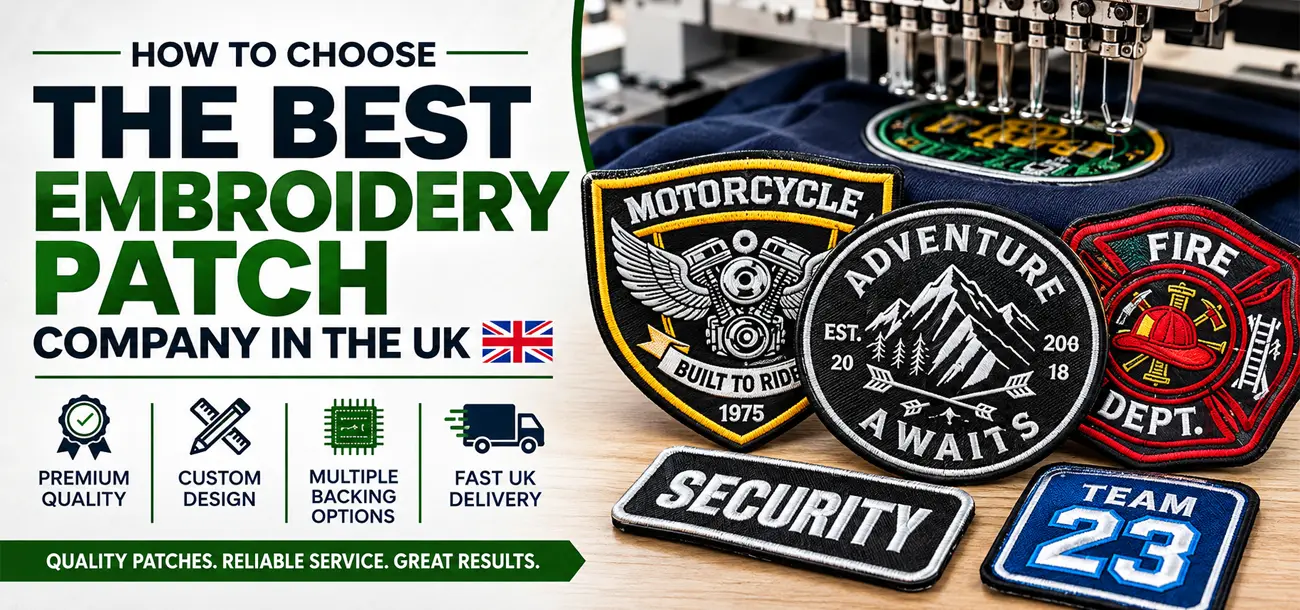
Ever ordered something online that looked perfect in the pictures, only to be disappointed when it arrived? Embroidered patches can be just as disappointing. A design may look impressive on screen, but uneven stitching, dull colours, or poorly finished edges can make the finished patch look completely different. The even scarier part is if you order embroidery patches in bulk from the wrong place. Oops… That is why choosing the right supplier matters.
Whether you are creating patches for a clothing brand, sports team, school, company, or personal project, you need a supplier that understands both quality and practicality. Finding the Best Embroidery Patches UK is not simply about choosing the cheapest quote. It means looking at craftsmanship, customisation, backing, delivery, and service before ordering patches online.
What Makes the Best Embroidery Patch Company?
The best embroidery patch UK company combines high-grade materials, precise digitising, and flexible order terms to turn artwork into durable, retail-quality badges. A reliable supplier should be able to produce a patch that looks like your approved design while providing a practical and consistent service from artwork to delivery.
Here are some of the signs of what makes a high-quality embroidered patch:
- Good embroidery quality: High stitch density is essential, as the feel, look, and a large portion of the experience depend on the density. A top-tier company ensures designs are not sparse or flimsy, preventing the underlying twill fabric from showing through unless it is an intentional design choice.
- Material quality: Premium manufacturers use heavy-duty, commercial-grade twill backing and high-tensile rayon or polyester threads, as they understand the significance of quality in patches. Preventing patches from curling, puckering, or shrinking when exposed to heat and moisture is what they ensure.
- Clear borders: Whether using a traditional tight-knit Schiiffli merrowed border for standard shapes or a precise laser-cut border for intricate, non-standard shapes, the edges must be completely sealed to prevent fraying over time.
- Strong stitching: Tight underlay stitching and locked-off ends ensure that individual threads won’t pull or snag if the patch catches on a sharp surface or undergoes frequent friction.
- Accurate colours: The best custom patch suppliers use standardised thread-matching systems (like Pantone/PMS matching) and offer digital and physical proofing so the final product precisely matches your brand guidelines.
- Professional finishing: This involves meticulous quality control – clipping stray jump threads, applying backing adhesive evenly (so iron-on glue does not bleed out or peel prematurely), and ensuring a flat and uniform shape.
- Reliable customer support: Clear communication during the artwork digitising phase, proactive updates on production timelines, and solid reprint policies protect you from costly mistakes on large orders.
If you are still unsure how to choose an embroidery patch company, start with the basics:
- Look at the company’s previous work,
- Understand what is included in the quote,
- Make sure its production process matches your requirements.
Check the Quality of Embroidered Patches
Quality should be one of your first considerations when comparing UK Embroidery Patch Suppliers. Product photographs can give you an idea of the overall appearance, but close-up examples are much more practical for assessing embroidery.
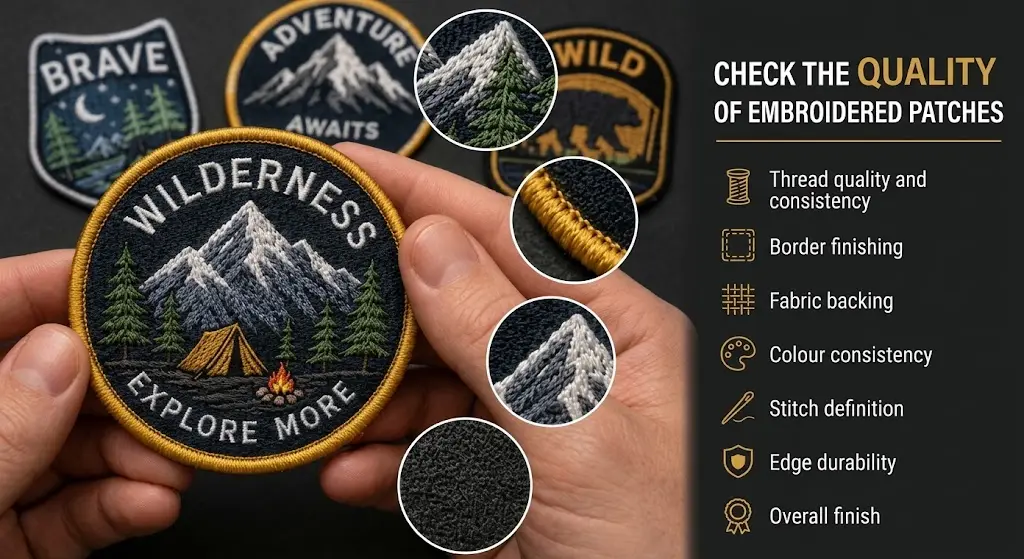
Look at the stitch density. A suitable stitch pattern should provide good coverage without making the design look excessively bulky. Fine lettering and minute details also need to be handled meticulously because embroidery has physical limitations that do not apply to a digital image.
You should also check:
- Thread quality and consistency,
- Border finishing,
- Fabric backing,
- Colour consistency,
- Stitch definition,
- Edge durability,
- Overall finish.
Pro tip:
Previous work of a company tells you a great deal about a supplier. When considering getting custom embroidered patches UK, look for examples that are similar to your own design rather than judging a company entirely on one impressive image.
Also, for larger orders, asking whether a digital proof or physical sample is available can also help you identify potential problems before the entire batch is produced.
Compare Custom Patch Design Options
One of the biggest advantages of ordering custom patches is the ability to create something that represents your brand, team, organisation, or personal design.
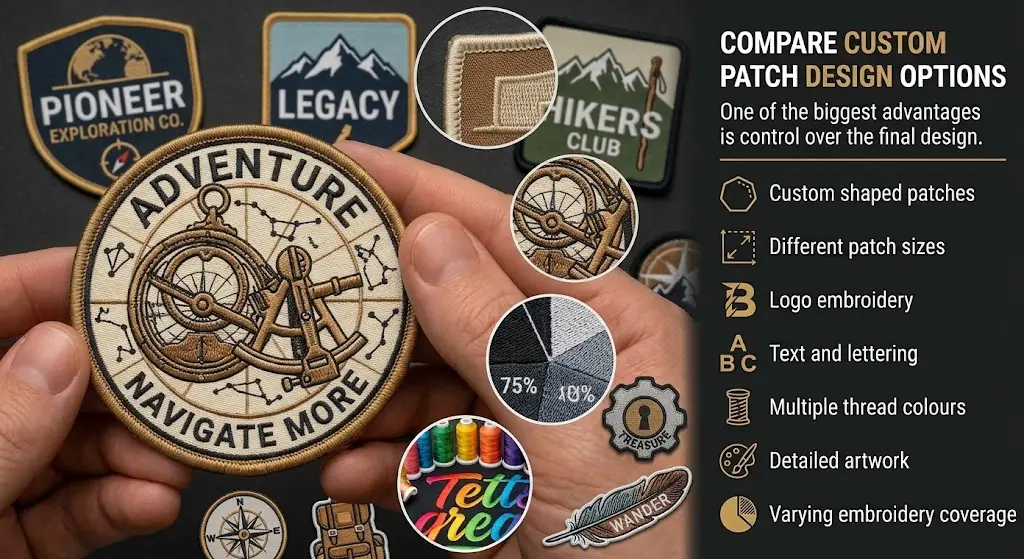
So when you compare a custom embroidery patch manufacturer, check how much control you have over the final design. Depending on the supplier, you may be able to choose:
- Custom shaped patches,
- Different patch sizes,
- Logo embroidery,
- Text and lettering,
- Multiple thread colours,
- Detailed artwork,
- Varying embroidery coverage.
A good custom patch design service must also help customers understand what will and what will not work as embroidery and how they will translate an image into an embroidery patch. Small text, intricate details, and complex gradients may need to be simplified before production.
For businesses and clothing brands, it is also worth checking whether the supplier can maintain consistency across repeat orders. This can become important when patches form part of a recognisable brand identity.
Look at Available Patch Backing Options
Backing affects how a patch is attached and how well it suits its intended application. The right choice depends on the garment, frequency of use, and whether you need to remove the patch later.
Iron-on Backing (Heat Seal)
This features a layer of heat-activated adhesive on the back that melts into garment fibres when pressed with a home iron or commercial heat press. It offers quick application but degrades after repeated washing. Iron-on patches are convenient and can work well for many jackets, garments, and casual applications.
Sew-on Backing (Plain Backing)
This type of backing features no chemical adhesive, leaving the raw fabric or backing paper exposed. It relies entirely on thread around the borders for a permanent, lifetime hold. It can be a practical choice where a secure, long-term attachment is important, including some uniforms, jackets, and workwear.
Velcro Backing
Velcro can be useful when patches need to be removed or replaced regularly. It is particularly practical for some uniforms, tactical-style clothing, bags, biker patches, and equipment where interchangeable patches are required.
Peel-and-Stick Backing
Adhesive backing provides a quick way to attach a patch and may be appropriate for temporary or promotional uses. However, it may not provide the same long-term solution as sewing for frequently washed garments.
Hoop-and-Loop Backing
Hook-and-loop backing allows a patch to be attached and removed repeatedly. It can therefore be useful where designs, names, or identifiers need to be changed.
Compare Prices Before Ordering
Price naturally matters when looking for Custom Patches UK, particularly if you need hundreds of pieces. However, comparing suppliers based solely on the cheapest quotation can be misleading.
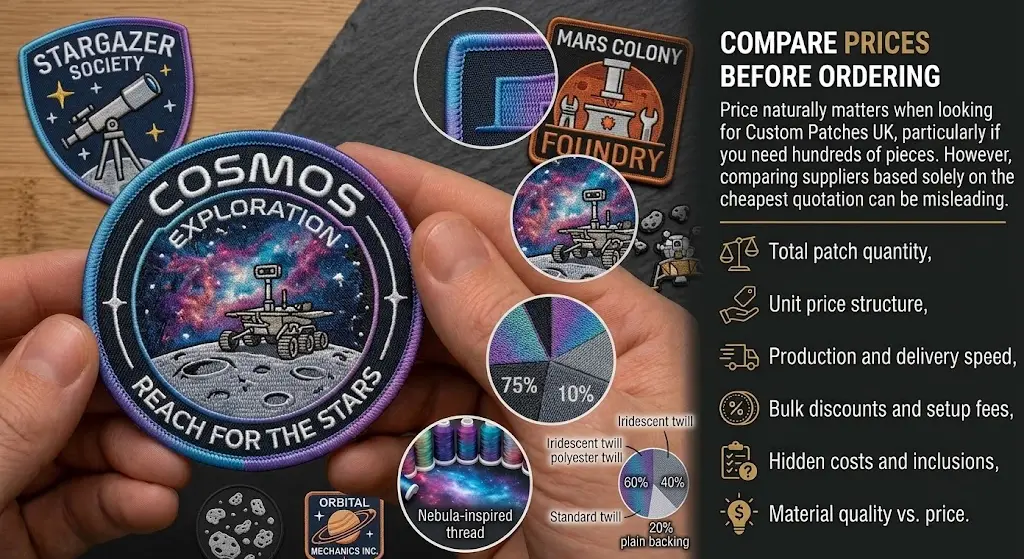
The price of an embroidered patch may depend on:
- Patch size
- Number of patches ordered
- Design complexity
- Number of thread colours
- Embroidery coverage
- Backing type
- Artwork preparation
- Production speed
- Delivery method
For example, a small batch featuring a detailed design may cost more per patch than a large order of a simpler design.
So when you are requesting quotations, make sure you compare like for like. Ask whether artwork preparation, setup, backing, and delivery are included in the quoted price.
Do not aim to look for the lowest price; instead focus on what you are getting for the price. That approach helps you compare the best custom patch supplier UK options based on overall value rather than an attractive headline figure.
Check Minimum Order Quantities
Before submitting artwork, check the supplier’s Embroidered Patch Minimum Order. This is particularly important for individuals and small businesses. You might only need 10 patches for a new clothing collection, while a security company or sports organisation could require several hundred.
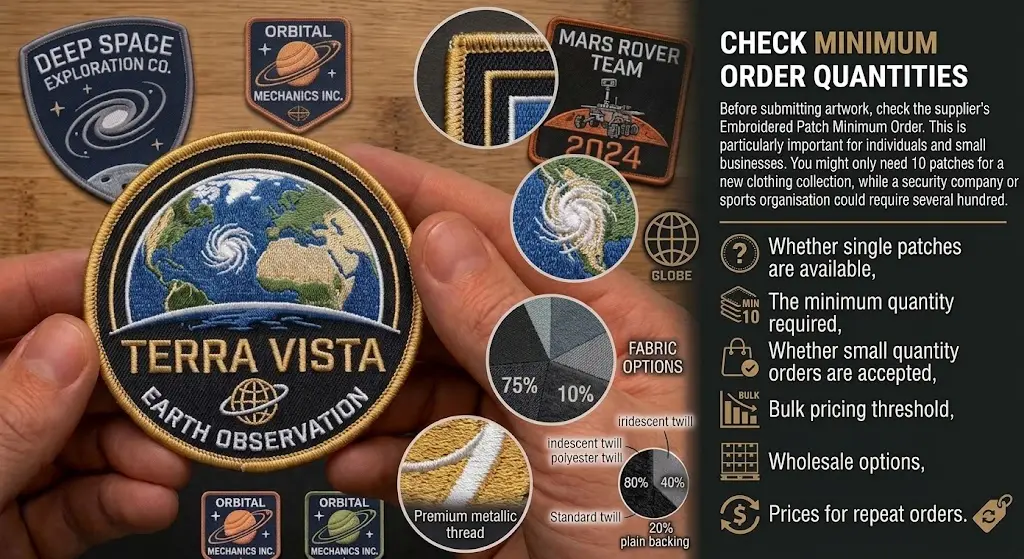
Before ordering, check:
- Whether single patches are available,
- The minimum quantity required,
- Whether small quantity orders are accepted,
- Bulk pricing threshold,
- Wholesale options,
- Prices for repeat orders.
If you are testing a new product, a large minimum order could leave you with more stock than you actually need. Equally, if you are ordering for a large organisation, it may be worth asking about bulk pricing.
Consider Turnaround and UK Delivery
A supplier can produce an excellent patch, but that does not help much if the order arrives after your event, product launch or uniform deadline. Therefore, before ordering, ask about the complete timeline. This should include artwork approval, production, dispatch, and delivery.
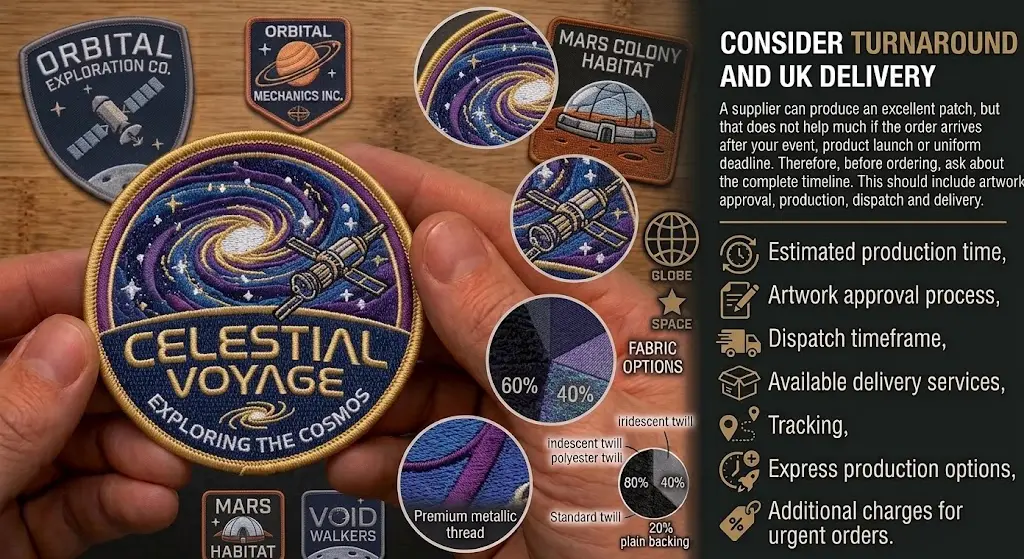
For Embroidered Patch Delivery UK, check:
- Estimated production time
- Artwork approval process
- Dispatch timeframe
- Available delivery services
- Tracking
- Express production options
- Additional charges for urgent orders
Also, if you need patches for a specific date, tell the supplier before confirming your order. Do not rely solely on a general delivery estimate shown on a website. And for large orders, allowing some extra time between the expected delivery date and your actual deadline is sensible. It gives you room to deal with unexpected production or delivery delays.
Read Reviews and Check Previous Work
Customer reviews can provide useful information that you will not necessarily find on a supplier’s product pages. When researching where to buy embroidered patches UK, customers can rely on and look beyond the overall star rating. Read individual reviews and look for recurring comments about:
- Patch quality
- Communication
- Delivery
- Design assistance
- Accuracy of the finished product
- Packaging
- Customer service
- How queries were handled
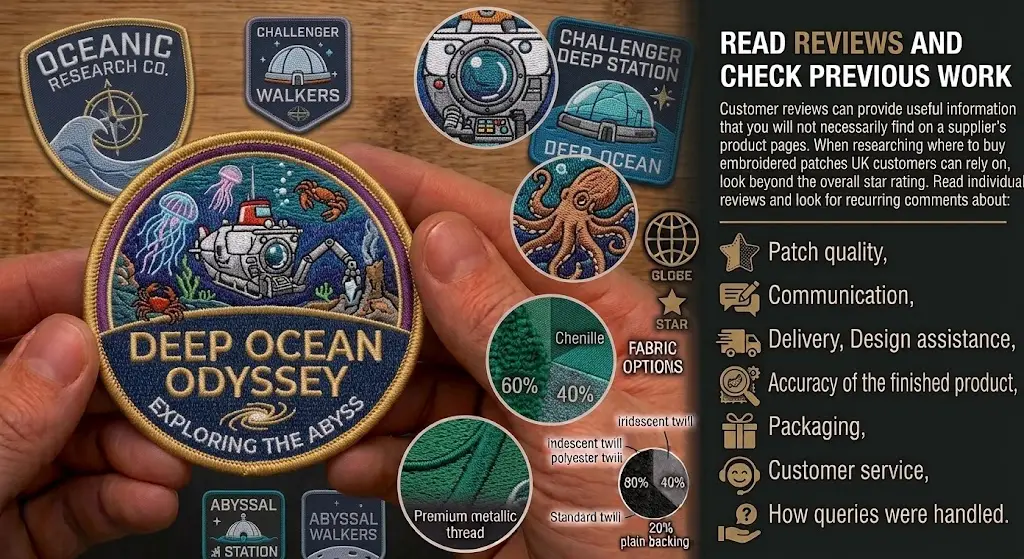
Customer reviews are pragmatic because they give you feedback outside the supplier’s own marketing material. You should also examine the company’s portfolio. Are the examples comparable to what you need? If you require a detailed company logo, for example, look for examples involving detailed lettering and shapes rather than only simple designs.
Why Choose Embroidery Patches UK?
When comparing companies to place your order for patches, Embroidery Patches UK can be considered alongside other companies based on the specific requirements of your project. The service area worth assessing includes customisation, embroidery quality, design support, backing choices, order quantities, pricing and UK delivery.
These factors help identify whether a UK patch manufacturer is suitable for a particular project. Someone ordering 20 patches for a small clothing collection may have different priorities from a business ordering hundreds of patches for uniform badges.
An important point to understand here is: Do not choose an embroidery patch UK company based on its high in search results on the Google. Instead, compare its actual offering with your requirements. Look at the design process, production details, minimum quantities, and delivery options before making up your mind. This makes the purchase decision more objective and reduces the risk of choosing a supplier based on marketing claims alone.
Final Thoughts
Choosing the Best Embroidery Patch Company UK requires a little more research than simply comparing prices. The quality of the stitching, materials, borders, and backing can have a major impact on how the final patch looks and performs.
Before ordering, make sure to look for custom embroidered patches UK, check the minimum order quantity, review pricing, and ensure the supplier offers a backing suitable for your intended use. Also, it is equally important to check the production time, customer reviews, and samples for proof.
Embroidered Patches can be included in your shortlist while you compare suppliers against these practical criteria. Taking the time to assess quality, value, and service will give you a much better chance of receiving patches that meet your expectations.

0 Comments on “How to Choose the Best Embroidery Patch Company in the UK”